What Is a QLK Bracket and Why Do You Need One?
A QLK bracket is a mounting bracket that attaches permanently to your wheelchair frame. Once installed, it allows your wheelchair to lock directly into a Q'Straint QLK floor-mounted docking receiver in a transport vehicle — no straps required. The wheelchair clicks in automatically as you roll into position and releases with a simple lever.
For the QLK system to work, two things must be in place: a QLK floor receiver installed in the vehicle, and a compatible QLK bracket installed on your specific wheelchair. This guide focuses on the bracket — how to determine if your wheelchair can accept one, and what measurements you need to order the correct bracket for your chair.
Already have a QLK receiver in your vehicle? You're halfway there. Now you need the right bracket for your specific wheelchair frame. Use this guide to identify which bracket fits your chair, then shop QLK brackets here.
Step 1 — Is Your Wheelchair Compatible with a QLK Bracket?
Not every wheelchair can accept a QLK bracket. Before measuring anything, confirm your chair meets the basic compatibility requirements.
- Manual wheelchairs with round lower frame tubing
- Standard adult power wheelchairs (check model)
- Sport/active chairs with camber tube and seat cross tube
- Split or bi-level frame wheelchairs (bracket may need bending)
- Chairs with lower frame rail height greater OR less than 6" from ground
- Wheelchairs with non-round (oval or square) lower frame tubing
- Aluminum or titanium frames (bracket adds up to 18 lbs — may be undesirable)
- Power chairs with seat elevating systems (must verify actuator clearance)
- Chairs with extensive custom accessories or non-standard modifications
- Pediatric chairs (consult us before ordering)
Unsure if your specific wheelchair is compatible? QLK brackets are developed using standard wheelchair models and are not guaranteed to work with all custom configurations or accessories. Contact our team with your wheelchair make, model, and year before ordering — we can confirm compatibility in most cases the same day.
Step 2 — Manual Wheelchair Measurements
If you have a manual wheelchair, you need three measurements before ordering. Take these with a tape measure and calipers if available — accuracy matters for bracket fit.
Confirm Your Lower Frame Rail Is Round Tubing
Look at the lower horizontal tube that runs along the bottom of your wheelchair frame — the one closest to the ground. QLK brackets attach to this tube. It must be round in cross-section. If the tube is oval, square, or rectangular, a standard QLK bracket will not fit correctly.
If you are unsure, roll the chair onto its side and look at the end of the tube — a round tube will appear as a perfect circle.
Measure the Outside Diameter of the Lower Frame Rail
Using calipers or a measuring tape wrapped tightly around the tube, measure the outside diameter of the lower frame rail. This is the measurement across the full width of the tube from outside edge to outside edge — not the inside diameter.
Common lower frame rail diameters and what they mean for bracket selection:
| Outside Diameter | Common On | Frequency |
|---|---|---|
| 3/4" (19mm) | Lightweight manual chairs, pediatric frames | Less Common |
| 7/8" (22mm) | Standard adult manual wheelchairs | Most Common |
| 1" (25mm) | Heavy-duty manual chairs, some bariatric frames | Less Common |
| 1-1/4" (32mm) | Bariatric manual wheelchairs | Less Common |
Don't have calipers? Wrap a thin strip of paper tightly around the tube and mark where it overlaps. Measure the length of that strip — that is the circumference. Divide by 3.14 (π) to get the diameter. For example, a circumference of 2.75" ÷ 3.14 = approximately 7/8" diameter.
Measure the Frame Rail Height from the Ground
Measure the distance from the bottom of the lower frame rail to the ground while the wheelchair is sitting on a flat surface with a person of average weight seated in it (or with simulated weight if needed). This measurement determines which bracket profile you need.
- Greater than 6" from ground: Standard bracket profile
- Less than 6" from ground: Low-clearance bracket profile
This measurement is critical — ordering the wrong profile results in a bracket that sits at the wrong angle and will not engage the QLK floor receiver correctly.
Manual Wheelchair Frame Diagrams
Use these diagrams as a visual reference when measuring your wheelchair frame and identifying which bracket configuration applies to your chair.
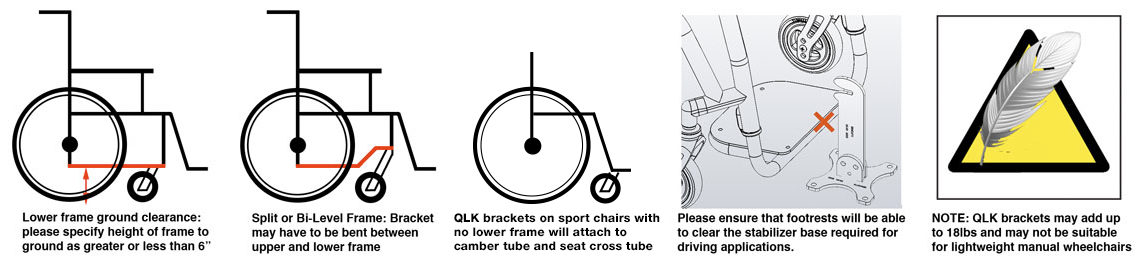
Frame type diagrams: lower frame ground clearance, split/bi-level frame, sport chair attachment, footrest clearance, and weight notice
Standard Frame
Specify lower frame height from ground as greater or less than 6"
Split or Bi-Level Frame
Bracket may need to be bent between upper and lower frame during installation
Sport Chair (No Lower Frame)
QLK bracket attaches to camber tube and seat cross tube instead
Footrest Clearance
Ensure footrests clear the stabilizer base required for driving applications
Lightweight Frame Notice
QLK brackets may add up to 18 lbs — may not be suitable for lightweight manual chairs
Important — Stabilizer bracket and footrest clearance: A stabilizer bracket is required for driving applications (when the wheelchair user is the driver of an adapted vehicle). The stabilizer bracket base may interfere with single footrests. Check footrest clearance before purchasing if the chair will be used in a driving application.
Lightweight frame notice: QLK brackets can add up to 18 lbs to your wheelchair. This additional weight may not be acceptable for users of aluminum or titanium ultralight frames, where weight is critical for mobility and self-propulsion. Consider this carefully before purchasing for a lightweight manual chair.
Step 3 — Power Wheelchair Measurements & Checks
Power wheelchairs require a different set of checks before ordering a QLK bracket. Unlike manual chairs, the concern is less about tube diameter and more about mechanical clearances and custom configurations that may interfere with bracket installation or function.
Check for Seat Elevating Systems
If your power chair has a seat elevating system, note whether the actuator is located inside the battery box. Actuator placement directly affects which bracket profile will fit without obstruction.
Check the Battery Box Area
The battery box is a common mounting zone for QLK brackets on power chairs. Note its dimensions and whether any wiring, connectors, or accessories occupy the intended bracket attachment area.
Note All Custom Accessories
Any aftermarket or custom accessories — elevating seats from third-party companies, ventilator mounts, communication device mounts — may interfere with bracket installation. List all accessories before contacting us.
Have Your Chair's Make, Model & Year Ready
QLK brackets for power wheelchairs are developed to fit specific models. Having the exact make, model, and year of your power chair is essential for ordering the correct bracket.
Power wheelchair important notice: QLK brackets for power wheelchairs are developed using standard models and are not guaranteed to work with additional accessories or custom configurations. Always contact our team before ordering a power wheelchair bracket if your chair has any custom modifications.
Step 4 — Order the Right Bracket
Once you have your measurements and have confirmed compatibility, you're ready to order. Here's what to have on hand:
- Wheelchair type: manual or power
- Chair make, model, and year
- Lower frame rail outside diameter (manual chairs)
- Frame rail height from ground: greater or less than 6"
- Frame type: standard, split/bi-level, or sport/no lower frame
- Any seat elevating systems or custom accessories (power chairs)
- Driving application? Yes or no — determines if stabilizer bracket is needed
Shop QLK Wheelchair Brackets
Browse our complete selection of Q'Straint QLK brackets for manual and power wheelchairs. Authorized dealer — all brackets ship directly from stock.
Browse QLK Brackets → English
 Chinese (Traditional)
 Danish
 French
 German
 Italian
 Japanese
 Russian
 Spanish